

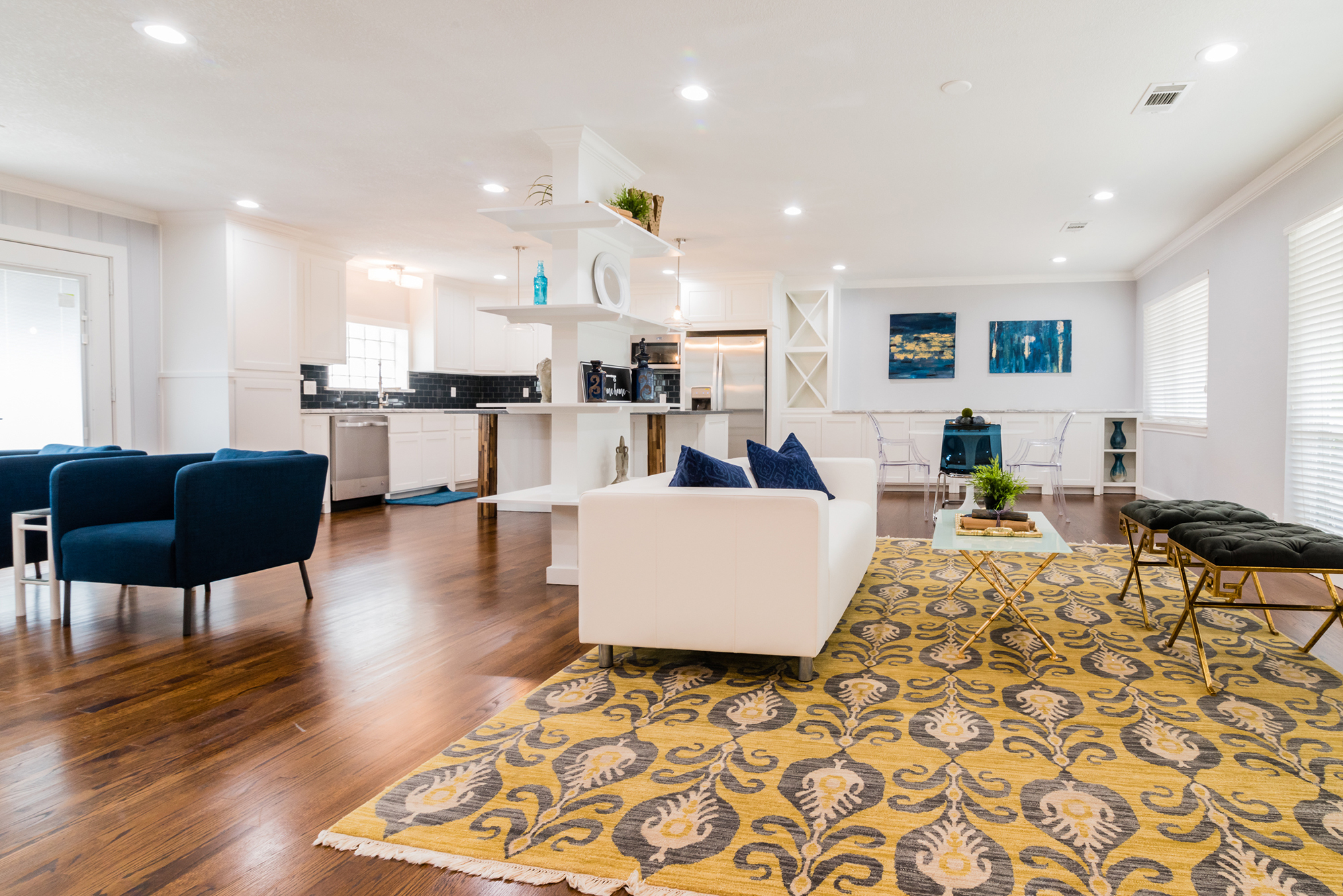
A sectional can make a living room feel comfortable, generous, and practical, but it can also make rug shopping strangely difficult. Unlike a standard sofa, a sectional has more visual weight, more legs, and often more than one direction of seating. That means the rug has to do more than “sit under the coffee table.” It has to organize the entire room.
At CarpetWorks, one of the most common area rug issues homeowners run into is scale. The rug may be technically beautiful, but if it is too small, the whole room feels disconnected. If it is too large, it can crowd doorways, vents, fireplace edges, or walk paths. The goal is not just buying a bigger rug. The goal is choosing the right rug footprint for how the room actually works.
Start with the sectional footprint, not the rug size
The biggest mistake is choosing a rug based on the room’s overall dimensions before looking at the sectional. With an L-shaped sectional or chaise sofa, the seating footprint usually becomes the true “room inside the room.” The rug should support that seating zone first, especially in open-plan living rooms where there may not be clear architectural boundaries.
A good rule is to make sure the front legs of the sectional sit comfortably on the rug, with enough rug extending beyond the coffee table and side seating areas. If the rug stops right at the sectional’s edge, the layout can look tight and accidental. If the chaise sits half on and half off the rug, the room may feel visually tilted. The rug should make the sectional look placed, not parked.
The front-legs-on method works for most CT living rooms
For many homes in Hartford, East Hartford, West Hartford, Manchester, and nearby areas, living rooms are not huge showroom rectangles. They often have radiators, bay windows, angled fireplaces, door swings, or older room proportions. In those cases, the front-legs-on method is usually the most practical choice.
This means the front legs of the sectional and any accent chairs sit on the rug, while the back legs can remain off. It gives the furniture a connected look without forcing the rug wall to wall. This method works especially well when the room needs clear walking space behind the sectional or around a coffee table. It also helps avoid the common problem of using a rug that looks like a small island floating in the middle of the room.
Chaise sectionals need more rug depth
A chaise changes the rug calculation because it stretches one side of the seating layout forward. If the rug is sized only to the shorter side of the sectional, the chaise can look like it is hanging off the room. This is where many awkward living rooms start to feel unbalanced.
For chaise sectionals, the rug should usually extend far enough under the chaise to make that longer seat feel intentional. The rug does not always need to cover the entire depth of the chaise, but it should not stop halfway in a way that creates a visual break. If there is a coffee table, leave comfortable space between the table and seating so the rug still feels useful rather than purely decorative.
Watch the walk paths and door clearances
Area rugs are not just visual pieces. They affect how people move through the room. In older CT homes, tight living rooms often connect directly to hallways, dining rooms, staircases, or front entries. A rug that looks perfect in a photo can become irritating if it catches under a door or narrows the walking path around a sectional.
Measure the open pathways before choosing the rug. Leave enough exposed floor for people to move naturally around the sectional without stepping half on and half off the rug every time. If a door opens into the room, check the clearance with both the rug and rug pad in mind. A thicker rug pad can make a low-clearance door rub or drag.
Choose shape carefully in awkward rooms
Most sectional layouts work best with a rectangular rug, but not every room behaves. Some living rooms have angled walls, bay windows, off-center fireplaces, or furniture that cannot be centered. In those cases, the rug should visually align with the seating area rather than the most confusing wall in the room.
This is where custom area rugs or carpet binding can become useful. If a standard size is always slightly too small, too wide, or too long, a custom-bound rug can create a cleaner fit. It can also solve rooms where a standard 8x10 or 9x12 almost works but leaves the furniture looking squeezed or uneven.
Do not ignore the rug pad
A rug pad is part of the sizing decision, not an afterthought. The pad should usually be cut slightly smaller than the rug so the rug edge can sit cleanly against the floor. If the pad is too thick or too close to the edge, it can create raised corners, uneven transitions, or a subtle trip hazard.
The right rug pad also helps the rug stay in place under heavy sectional use. Sectionals tend to anchor one side of the rug, while the open side can still shift from foot traffic, pets, kids, or a moving coffee table. A proper pad protects the floor, improves comfort, and keeps the room from slowly rearranging itself.
The right area rug can make a sectional feel grounded, balanced, and properly scaled to the room. It is especially helpful in CT homes where living rooms often have older proportions, mixed flooring, and layouts that standard rug sizes do not always respect.
Visit East Hartford, CT to explore area rugs, custom rug options, rug pads, and carpet binding solutions with CarpetWorks. We proudly serve New Haven, Waterbury, Hartford, East Hartford, West Hartford, Middletown, and Manchester, CT and can help you choose a rug that fits the room, the furniture, and the way your home is actually used. For help choosing the right size or custom option, contact us today.


