

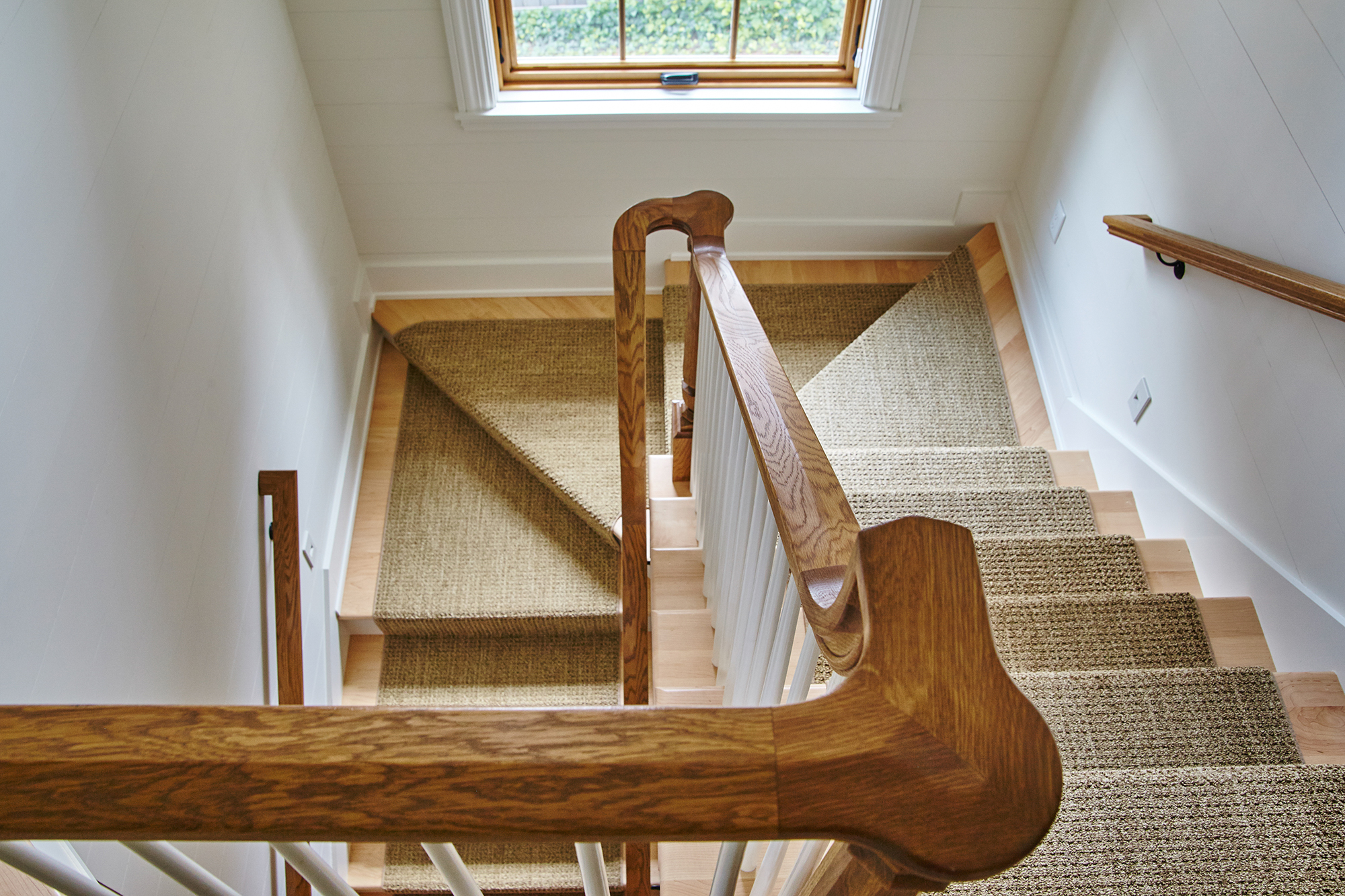
Wear Shows Up in One Spot Long Before the Rest
Every staircase has a handful of treads that take the brunt of daily traffic, usually the ones closest to the bottom of the flight or right before a landing where people naturally slow down or shift their weight. On an older colonial staircase with shallower treads, that wear concentrates even more tightly because there is less surface area to spread the impact across in the first place.
Checking those specific treads on a regular basis, rather than glancing at the runner as a whole, catches flattening or fraying while it is still a small, manageable issue. A runner that is rotated or adjusted early, before a worn patch becomes visibly thin, lasts considerably longer than one that is only addressed once the damage is obvious from across the room.
Vacuuming a Runner Needs a Different Approach Than a Floor Rug
A stair runner cannot be vacuumed the same way a flat area rug can, since the edges, corners, and the point where each tread meets the riser all trap dirt and debris that a standard pass with an upright vacuum will miss. This matters more on an older staircase where the runner was custom fitted and bound close to the edges of a narrow tread, leaving very little margin for error if a vacuum attachment is too wide to get into the corners properly.
A vacuum with a narrow crevice attachment, used along the edges and into the corner where the tread meets the riser, picks up the grit that causes the most long term wear to both the runner fibers and the binding. This is worth doing on a more frequent schedule than a typical floor rug, since stairs see more concentrated foot traffic per square foot than almost any other surface in a home.
Natural Fiber Runners Need Specific Handling
If a sisal, jute, or other natural fiber runner was chosen for its texture and durability, it comes with a maintenance profile that differs meaningfully from a wool or synthetic construction. These fibers can be more sensitive to moisture and to certain cleaning products, so a spill on a natural fiber stair runner needs to be blotted immediately rather than scrubbed, and a cleaning product that works fine on wool can sometimes discolor or weaken natural fiber strands.
Checking with whoever fitted the runner about the specific cleaning products safe for that fiber, before a spill happens rather than during the cleanup itself, avoids making an accident worse. This is a detail worth having on hand in writing, since it is easy to forget in the moment when something actually spills on the stairs.
Binding and Edges Deserve a Periodic Check
A runner cut and bound to fit a narrow staircase relies on that binding staying secure along every edge, since any fraying or loosening at the binding is both a safety issue and the starting point for more serious damage to the runner itself. This is especially true on a custom fitted runner, where the binding was finished specifically to that staircase's width rather than coming pre bound from a manufacturer in a standard size.
A quick visual check of the binding every few months, particularly at the edges closest to the most heavily used treads, catches a loose thread or a small fray before it unravels further. This is a small habit that prevents a much larger repair, and it is far easier to address a few inches of loose binding than to rebind an entire runner once it has started coming apart.
Know When It Is Time to Rotate or Replace
Even a well maintained runner eventually reaches a point where wear on the most traveled treads is noticeable enough that rotating or replacing a section makes more sense than continuing to patch it. On some staircases, particularly longer runs without a landing, it is possible to shift the runner slightly so a less worn section lands on the highest traffic treads, extending its usable life by a meaningful amount.
This is not possible on every staircase, especially shorter runs or ones with a landing where the runner was cut and fitted to an exact length, but it is worth asking about when the runner was first installed. Knowing in advance whether rotation is an option saves a homeowner from assuming full replacement is the only path forward once wear becomes visible.
Keep Your Staircase Looking Its Best
A stair runner fitted to an older colonial staircase is worth maintaining properly, since the custom sizing and fitting that went into it is not something a quick replacement can easily match. CarpetWorks can advise on cleaning routines, binding checks, and when a runner is ready for rotation or replacement based on how it was originally installed.
Explore our area rug and custom runner options, or visit us at East Hartford, CT. We support homeowners throughout New Haven, Waterbury, Hartford, East Hartford, West Hartford, Middletown, and Manchester, CT with runners of every age and style. Contact us if your staircase runner needs a closer look.


